

1. Give the timeline a question
A useful family timeline puts evidence in an order you can inspect. Start with a question: “Which records place Jilles Verschoor in Zwartewaal and Heenvliet, and what remains unknown between them?” Choose one person or family and a manageable period. A timeline becomes harder to interpret when every distant relative is treated as part of the same life.
The Verschoor project's owner permitted these examples of long-deceased people. The screenshots show existing production records. Historical readings are attributed to the project; the originals have not been independently re-read for this guide. No production records were changed for the examples.
This example follows Jilles, also recorded as Jillis, who died in Heenvliet on 11 November 1846. The project retains a provisional birth date of 16 October 1815 and a marriage on 14 October 1837. Its records describe a fisherman in 1837 and a labourer in 1846.
2. Collect dated claims and their sources
For each row, record the person, event or fact, date as supported, place and source reference. Distinguish an event date from the date the document was created. A marriage entry written in 1837 may report a birth in 1815; the birth statement belongs at 1815 with a citation to the later record.
- 16 October 1815: Jilles's retained birth date, with qualified support and a faded birth entry still requiring attention.
- 14 October 1837: Marriage to Neeltje van der Hoeven in Zwartewaal; fisherman and resident there according to the project's marriage reading.
- 11 November 1846: Death in Heenvliet; labourer and resident there according to the project's death reading.
The starting references are the 1837 marriage entry, 106 / 292 / entry 12 and 1846 death entry, 087 / 985 / entry 22. These rows summarize the project's claims. They do not replace the entries, citations or explanations of uncertainty.
3. Separate the person's life from family context
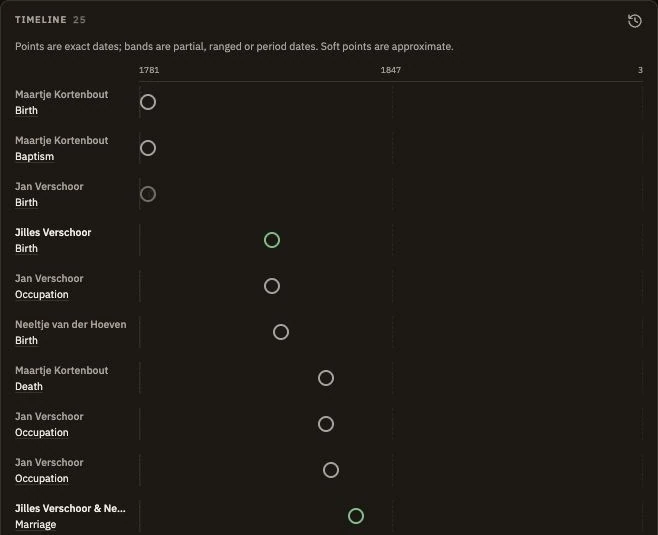
Keep family context when it helps answer the question: a parent's death, a partner's recorded residence or a child's birth can suggest useful searches. Identify whose event each row represents. A child's birthplace does not automatically prove that both parents were living there continuously.
Leaves draws relevant family events alongside a person's own facts. Its point and band shapes describe the stored date form. A precise point can still rest on uncertain information, as Jilles's birth date does here. Date precision and confidence in the evidence need separate consideration.
4. Keep gaps and changes visible
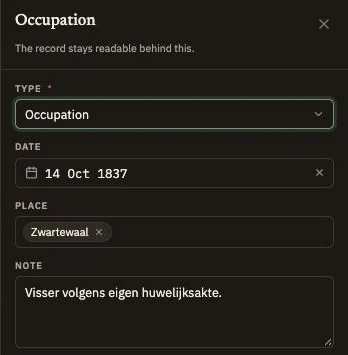
Two dated observations leave a gap between them. Zwartewaal in 1837 and Heenvliet in 1846 do not establish an arrival date, route or reason for moving. Likewise, two occupations do not prove a single uninterrupted career. Leave the interval open and use it to identify a question a new record might answer.
Keep estimated years, partial dates and before/after boundaries in their supported forms. Follow the uncertain dates guide rather than adding invented days to make rows sort neatly.
5. Check the sequence without forcing agreement
Use the sequence to spot questions: an age that does not fit a stated birthday, an event after death, or a parent link that creates an impossible generation. Check the underlying records and the identity of the people before changing dates. A warning can expose an import mistake, an interpretation problem or a distinct namesake.
Jilles's marriage reading reportedly gives age 22 two days before the 22nd birthday implied by the retained birth date. The timeline helps reveal the tension; it cannot determine its cause. Preserve it in the evidence comparison rather than changing the birth date to make the display agree.
6. Turn one gap into the next record check
Choose an action that could answer a specific gap. For a possible move, identify surviving records that could place the person between the two dated observations. For an age discrepancy, return to the birth evidence. State the proposed search separately from completed research.
Use the person timeline to return to the facts and citations, and the exploration views for a wider view. Record actual attempts in your research log. A timeline is most useful when every plotted claim can be traced back to evidence and every apparent gap remains a question.