

1. Identify the person and the entry
A death record may mention the deceased, a spouse, parents and the people making the report. Begin by checking the name, age, place, relatives and register reference. Keep similarly named people separate until the surrounding details support an identification.
The Verschoor project's owner permitted these examples of long-deceased people. The screenshots show existing production records. Historical readings are attributed to the project; the originals have not been independently re-read for this guide. No production records were changed for the examples.
The main example concerns Jilles Verschoor's death in Heenvliet in 1846. A second entry, for his widow Neeltje van der Hoeven in 1893, shows why death and registration dates need separate attention. The guides explain the project's stored readings, rather than offering new transcriptions of the original handwriting.
2. Separate the death date from the report date
Look for the wording that dates the death itself, then identify when the report or entry was made. Also distinguish a burial or funeral date if another record supplies it. Dates attached to an index, image or catalogue may describe a different part of the record's history.
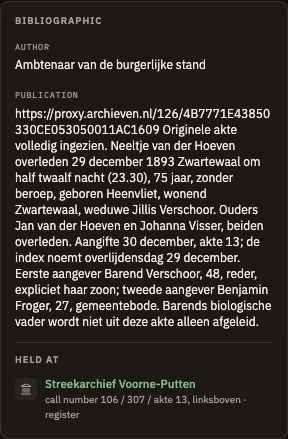
The reference is Zwartewaal death register 1893, 106 / 307 / entry 13, upper left. According to the project, the index also gives 29 December as the death day. Record the death on the date supported by the death statement; keep the report date in the citation or explanatory note.
3. Extract the death claim and its context
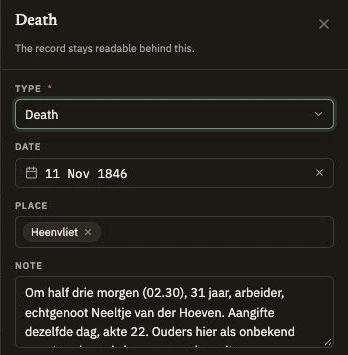
The retained reference is Heenvliet death register 1846, 087 / 985 / entry 22, upper left. The project reads death at 02:30 on 11 November, with the report made the same day. It identifies Jilles as a labourer and husband of Neeltje van der Hoeven.
Record separately what the entry establishes about death, current residence, occupation and relationships. Death place and residence may agree, but one should not be substituted for the other without reading the wording. The places guide explains that distinction.
4. Assess earlier-life statements separately
A record close to a death may still contain later information about a birth or parents. Consider who supplied that information and how they could know it. A stated age can guide a birth search, but it does not establish an exact birthday.
Jilles's entry reportedly gives age 31, leaves the parents unknown and contains a tentative November birth-month reading. The project retains the clearer October statement from the earlier marriage with qualified support. Unknown parents in this entry do not erase names supplied elsewhere. Compare the records using the conflicting evidence guide.
5. Read the informants and their stated roles
Copy the names, ages, occupations and relationships of informants where they are stated. In Jilles's entry, the project identifies Cornelis Verschoor, 34, as his brother, and Jan van Endbergen as a constable. Their roles provide different clues. A shared surname alone would not establish a sibling relationship, and a professional role does not establish kinship.
Neeltje's later entry reportedly calls Barend Verschoor, 48, her son and describes Benjamin Froger, 27, as a municipal messenger. The entry's reference to Neeltje as Jillis's widow does not, by itself, identify Barend's biological father. The witnesses and associates guide follows those distinctions.
6. Preserve the reading and the next step
Keep the archive reference, locator, exact wording you can read and any uncertainty. Label your transcription, translation and summary so another researcher knows which is which. Cite each extracted fact to the appropriate entry using the citation guide.
In Leaves, keep the death fact and supporting citations with the person, and use a research note for comparisons with earlier records. Choose a specific follow-up when a parent, age or informant needs checking. Completing the extraction does not require settling every statement about the person's earlier life.