

1. Ask whether two entries describe the same person
Two people can share a name, and one person can appear under several spellings. Start with a narrow question: does Jillis Verschoor in an 1837 marriage entry describe the person recorded as Jilles Verschoor in this family tree? Keep each source's wording while you compare it. A search result or a suggested duplicate is a candidate for investigation.
The Verschoor project's owner permitted these examples of long-deceased people. The screenshots come from production Leaves. Historical readings are attributed to the project; the originals have not been independently re-read for this guide.
The example concerns Jilles, born in 1815 according to the project's current conclusion and deceased in Heenvliet on 11 November 1846. The project identifies him as the Jillis who married Neeltje van der Hoeven in Zwartewaal on 14 October 1837. The reasoning depends on the surrounding family and life events.
2. Keep the name variants you actually find
Search both Jilles and Jillis, then check the entries behind the results. Look for spelling changes, initials, surname prefixes and forms used by different clerks. Preserve a source's spelling in a quotation or transcription even if you choose a different display name for your tree.
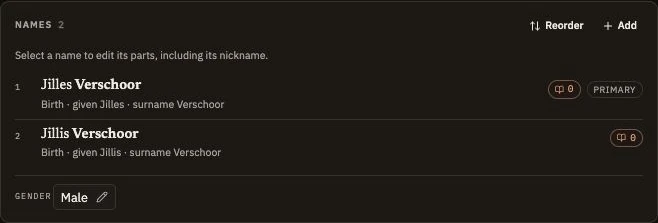
In Leaves, a person can have multiple names. See the person and name controls for the editing steps. Add a variant after checking its source. Merely adding two spellings to one person does not prove that they belong together.
3. Compare parents, partners and places
Make a short comparison of the details that could distinguish this person from a namesake. The project's marriage reading identifies Jillis's parents as Jan Verschoor and Maartje Kortenbout, and his wife as Neeltje van der Hoeven. Its later death reading names the same wife and connects him with Zwartewaal. These relationships carry more identifying detail than the given-name spelling alone.
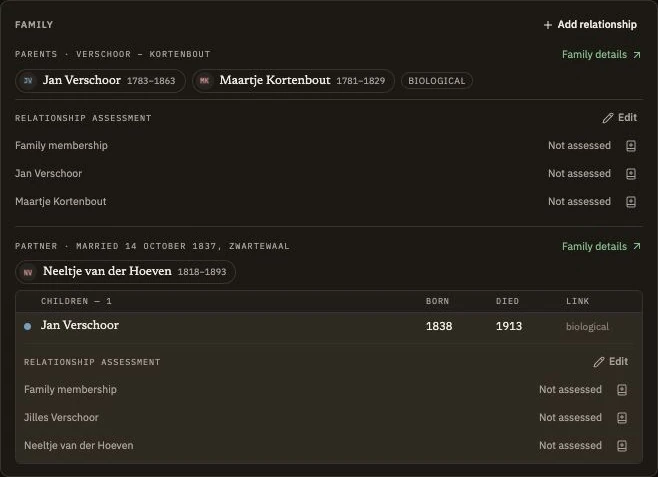
Read the 1837 marriage entry reference, 106 / 292 / entry 12 alongside the project's reading. Record which detail comes from which entry. Relatives copied between online trees can repeat one original assertion, so matching trees do not necessarily provide independent support.
4. Test the life sequence and the alternatives
Arrange the events in date order. Could the person have been alive, of a plausible age and in the relevant place? Different occupations at different dates can fit one life: this project records a fisherman in 1837 and a labourer in 1846. A change needs consideration, rather than automatic rejection.
Actively look for competing candidates. The existing research note distinguishes a Jilles who died as a baby in 1814 and a Jillis who died aged two in 1874. Neither can be the adult groom of 1837. Treat these as the project's recorded distinctions; recheck the underlying entries before relying on them in your own research. Do not add either namesake's relatives to the groom's family.
5. Explain the disagreements as well as the matches
A useful identity note lists the evidence for the match, the competing candidates considered, and the details still unexplained. Here, the marriage age and birth statement do not quite agree: age 22 on 14 October 1837 conflicts with a stated birth date of 16 October 1815, two days before that birthday. The project retains this discrepancy.
The later death reading reportedly leaves the parents unknown. Missing information does not by itself contradict named parents in an earlier record. An explicitly different parent pair would require a closer comparison. Keep the date question visible using the conflicting evidence guide; do not silently alter a date to make the identity appear tidier.
6. Decide before merging or adding relationships
Write a conclusion proportionate to the evidence: supported match, distinct people, or unresolved. Explain the relevant relationships and chronology, with citations to each claim. If the evidence cannot distinguish two candidates, keep them separate and plan the next check.
When two existing tree records really are duplicates, review their facts, names, citations, notes and family connections before using the duplicate review workflow. A shared name is insufficient grounds for a merge. After a supported merge, inspect the resulting person and relationships so that the evidence and outstanding questions remain understandable.