

1. Identify the entry before copying facts
A marriage entry can describe the couple, their parents, occupations, residences and earlier events. Read it as a collection of statements, each about a particular person at a particular time. Begin by recording the archive, locality, register, year, entry number and position on the image. Check that the image matches the index result.
The Verschoor project's owner permitted these examples of long-deceased people. The screenshots come from production Leaves. Historical readings are attributed to the project; the originals have not been independently re-read for this guide.
This example uses the marriage of Jillis Verschoor and Neeltje van der Hoeven, recorded in Zwartewaal on 14 October 1837. The retained reference is 106 / 292 / entry 12, entire left page. The examples below explain how the existing project organizes its reading; they are not a fresh transcription of the handwriting.
2. List the people and their separate claims
Make a working list before entering anything. For each statement, identify its subject, wording, date context and supporting location. Keep the groom distinct from his father, and the bride distinct from another person with the same given name. A witness is not automatically a relative.
- The couple's marriage: 14 October 1837 in Zwartewaal.
- The groom's occupation at that time: the project reads visser, meaning fisherman.
- The groom's residence at that time: Zwartewaal.
- The groom's reported birth date: 16 October 1815, a statement about an earlier event.
- The bride's reported birth date: 6 January 1818 in Heenvliet, also an earlier event.
This is a selection of the project's claims, not every statement in the entry. Keep the original Dutch wording with your reading and identify any translation as yours. Uncertain words should remain uncertain, rather than being filled from what you expect a marriage entry to say.
3. Give each fact the date it describes
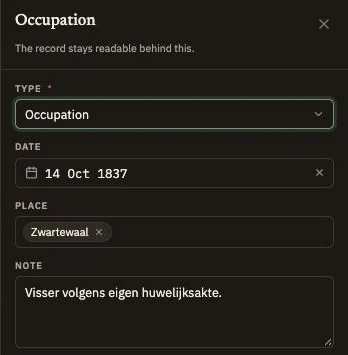
The marriage date belongs on the marriage. The occupation and current residence can be recorded as facts at that date when the wording supports them. The reported birth date belongs on the person's birth fact, with a citation to this later marriage entry. Do not date all extracted facts to 1837 merely because that is when the document was created.
Likewise, parents described as deceased by the marriage provide a boundary unless the entry explicitly supplies their death dates. Preserve the distinction between a reported exact date and an inference. The uncertain dates guide explains estimates and before/after dates.
4. Cite each supported claim to the same source
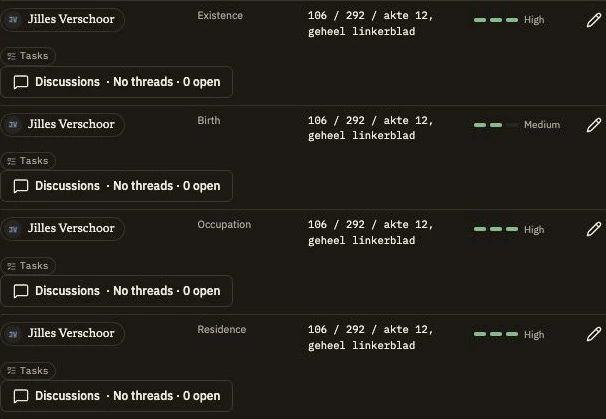
Create one source description for the entry, then cite it on the individual facts it supports. Include the precise locator so that a reader can recover the passage. In Leaves, the source's citation list shows where it is used. The citation guide covers the distinction between a source and its use for a claim.
A citation to a couple's union is different from a citation to their marriage date. A person-level citation also does not explain every birth, occupation or relationship on that person. Check the target of each citation and assess that particular use.
5. Assess statements about earlier events separately
A marriage entry is close in time to the marriage, but years later than the couple's births. Ask how the earlier information was supplied and whether supporting extracts survive. Do not give every fact the same confidence simply because it appears in one formal document.
The project retains a specific tension: the groom is reportedly 22 at marriage, yet his stated birth date would make his 22nd birthday two days later. That mismatch belongs in the research note. His own birth entry is faded and has not yet provided a fully independent readable confirmation. Keep the marriage's birth statement useful without describing it as a verified contemporary birth record.
6. Review the whole entry once more
Before finishing, compare your working list with the tree. Check the people, name spellings, dates, places, citations and unresolved words. Use the identity guide before attaching a claim to a namesake. Do not create new parents or merge records solely because the entry contains familiar names.
In Leaves, the source and citation controls and person facts keep this work connected. Put the longer comparison in a research note, and turn the next document check into a task. An extraction is complete when each copied claim has a clear subject, date context and reference, with the remaining uncertainty still visible.