

1. Choose a manageable story and audience
Start with one person, couple or branch and decide who will read the result. A short account of a couple's lives can be easier to finish and check than a book containing every known descendant. Write down its scope, a working title and the questions it should answer. Decide whether living relatives will be included and obtain the permissions needed for their stories and photographs.
This guide uses Jilles Verschoor (1815–1846) and his marriage to Neeltje van der Hoeven as a small historical example. The Verschoor project's owner permitted the screenshots. Historical readings come from the project; the originals have not been independently re-read for this guide. The book form was an unsaved draft: no PDF was generated and no production records were changed.
2. Prepare the evidence before the prose
Review names, dates, relationships and citations for the people you intend to include. Resolve errors you can demonstrate and keep genuine disagreements visible. A generated narrative can repeat a mistaken relationship as fluently as a correct one. Use the tree-review checklist before turning unreviewed material into a permanent family keepsake.
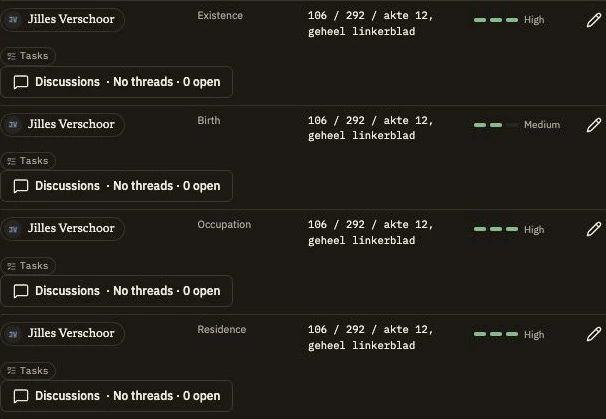
The project cites the 1837 Zwartewaal marriage entry, number 12. Use an event like this to organise a chapter around a documented change in a life. Keep the source's statements separate from your explanation. Add historical context only when you can cite it; an occupation or address does not establish a person's feelings, motives or daily routine.
3. Assemble the book sections in Leaves
Open Tools → Reports, choose Family history book and enter a title. Choose Add section, its report type and a starting person. Check the person's dates in the search result so a namesake does not enter the book. An individual summary is a useful first section when you want a compact, focused account.
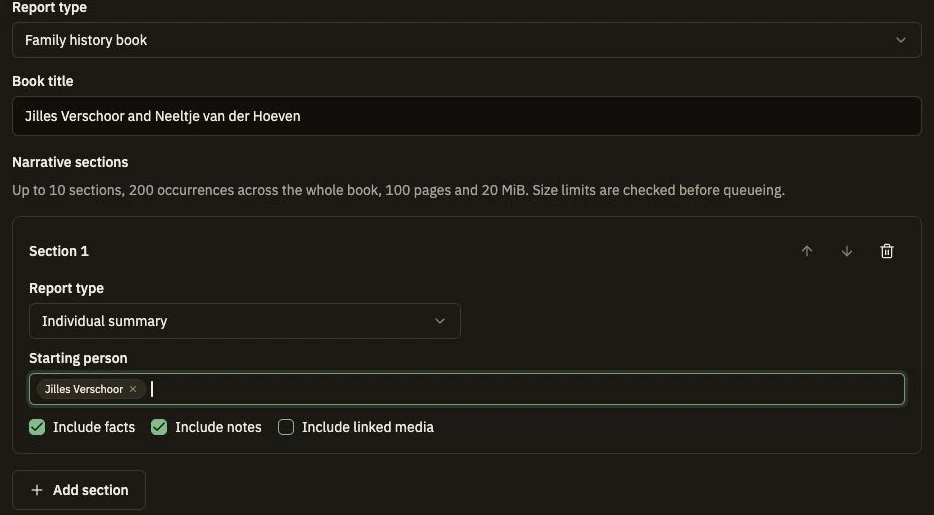
Add an Ahnentafel ancestor narrative or descendant narrative when the scope calls for one. Choose generations and parentage options deliberately, including whether disputed parentage should appear with labels. Descendant numbering can follow Register or d'Aboville conventions. Move sections up or down to create a sensible reading order and remove repeated material that does not help your audience.
4. Choose notes and images deliberately
Review each section's facts and notes options. Notes written for private research may contain unfinished arguments, personal information or material a relative supplied in confidence. Include explanations readers need, with uncertainty expressed plainly. Do not turn “possibly” into a definite statement merely to make a paragraph flow.
Linked media can be included in individual-summary sections; the ancestor and descendant narratives do not embed media. Check captions, image rights and legibility before including scans. Use the photograph guide to prepare identifications and credits. If you want a separate introduction or custom editorial chapters, prepare those in your writing tools rather than assuming the report form supplies them.
5. Generate a copy and proofread the PDF
Check the current limits in the form: up to ten sections, 200 occurrences across the book, 100 pages and 20 MiB. Repeated appearances count towards the occurrence limit. Owners can export; collaborators need export permission. Choose paper size and orientation, then Generate PDF. Wait for processing and page-reference resolution to finish before downloading. The reports manual explains availability and limits.
Read the PDF from beginning to end. Check headings, contents, person and source indexes, citations, image placement, uncertain dates and relationships. Ask another reader to check one section against its evidence. Fix the underlying research when needed and generate a fresh copy; editing a record later does not update a PDF already captured.
6. Share a dated edition and keep the research
Keep a dated final copy with its scope and corrections contact. Review living-person information in the actual downloaded file before sending it: project access changes cannot recall copies already distributed. Preserve the editable research, original media and a separate backup. A book makes the story readable, while those records let the next researcher check and extend it.