

1. Name the relationship you are investigating
Write the question as a connection between two identified people: “Was Jan Verschoor the father of Cornelis Verschoor, who died in Zwartewaal in 1826?” A surname and a plausible age are starting points. The task is to find evidence that connects this child with this parent, while considering other people with the same name.
The Verschoor project's owner permitted these examples of long-deceased people. The screenshots show existing production records. The historical readings come from the project; the originals have not been independently re-read for this guide. No production records were changed for the examples.
This example concerns Cornelis, whose birth is estimated around 1754, and the older Jan recorded as his father. The project's reading of Cornelis's own death entry names Jan Verschoor and Neeltje Zwartveld as his parents, both already deceased. That provides a specific family to investigate without supplying birth dates or a wedding date for the parents.
2. Find what the source actually says
Read the relevant passage and identify its subject. Does it explicitly name a parent, describe a guardian, identify an adoptive relationship, or merely put two people in one household? Preserve the wording and its context. A person appearing as a witness is not automatically a parent.
The retained reference here is Zwartewaal death register 1826, 106 / 300 / entry 24, upper right. According to the project, the entry describes Cornelis as the adult son of Jan Verschoor and Neeltje Zwartveld. The same document also mentions Cornelis's own wife. Keep the older parent pair distinct from Cornelis's partnership and from his son Jan.
Ask who supplied the information, when it was recorded, and how clearly it can be read. An explicit parent statement is valuable, but it still needs to refer to the right people. Where available, compare a birth or baptism entry, marriage documents and other independently informative records.
3. Separate the tree's structure from its evidence
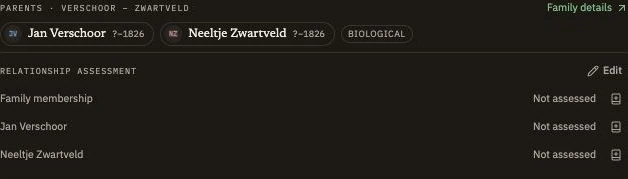
A line in a family tree records a connection someone entered. It does not tell a reader how that connection was established. Keep evidence beside the relationship and write an explanation of the identification, including competing candidates and unresolved points.
In Leaves, distinguish family membership, the type of relationship to each parent, and the assessment of each parent connection. The membership can be under review while one individual parent link has stronger support than another. A person-level source citation is useful context, but a direct citation on the relevant connection makes its purpose clearer.
4. Keep relationship type and certainty separate
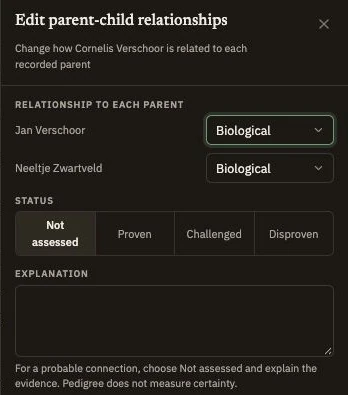
Use a type such as biological, adopted or foster when it describes the relationship supported by the evidence. Do not use a different type merely to signal uncertainty. Record that uncertainty in the assessment and explanation instead. If the type itself is unknown, retain that distinction as well.
The family and relationship manual explains the editing controls. The example's current settings are shown as they are; this guide does not change them or claim that a formal relationship review has been completed.
5. Test the identity and chronology
The older Jan cannot be replaced by the later Jan born around 1783: the latter is recorded as Cornelis's son, while Cornelis himself was born decades earlier. Use partners, places, life events and source wording to distinguish generations. Consult the identity guide before combining namesakes.
Look for contradictions as well as agreement. An impossible chronology, an explicitly different parent pair, or two distinct families in the same place may require more work. An omitted parent's name in one later record is different from an explicit contradictory statement. Keep the difference visible in your notes.
6. Leave a conclusion someone can review
State which connection you currently accept, which entries support it, how the people were identified and what remains unconfirmed. Add citations to the claims they support. If the evidence cannot distinguish candidates, keep the connection tentative rather than filling the gap with the most convenient person.
Before continuing another generation backwards, check the link just established. You may know that Jan and Neeltje were Cornelis's parents while still lacking their own origins. That is a useful result. Keep unknown birth and marriage dates blank, and make the next search a specific task using the dead-end research guide.