

1. Begin with yourself and one generation
Write down your own name, then add your parents and grandparents where you know them. Record birth, marriage and death details only to the precision you can support. A name and an approximate year are a useful starting point; an empty field is better than an invented date. Keep birth names and later names separately when you have both.
Choose one question before expanding the tree: where a grandparent was born, for example, or which record names their parents. Following one relationship gives you a manageable piece of research to check. A matching name in another tree is a lead to investigate, rather than enough evidence to join two families.
2. Ask relatives what they remember and what they kept
A conversation can explain a photograph or place name that no database will explain for you. Ask permission to take notes or make a recording, and record who spoke, when you talked and whether they witnessed the event or heard about it from someone else.
- What names and nicknames did the family use?
- Where did they live, and who else lived in the household?
- Who appears in this photograph, and how do you recognise them?
- Are there letters, certificates, family books or notes you could copy?
- Which details are uncertain, and who else might remember?
Keep the original wording alongside your interpretation. “Around the end of the war” should remain a remembered phrase until you have evidence for a more precise date.
3. Give every important fact a source
A source is the record or account you consulted. A citation identifies the particular entry that supports a claim. Record enough detail to find it again: the archive or owner, collection, volume, page or entry number, and a link and access date where useful. Keep a transcription of the relevant words and distinguish those words from your conclusion.
Here is a fictional example: “Exampletown birth register, 1882, entry 47, held by Example Archive; consulted 24 October 2026.” The entry might support a birth date and name, while a later census supports an occupation. Cite each claim where you use the evidence rather than attaching one unexplained document to the whole person.
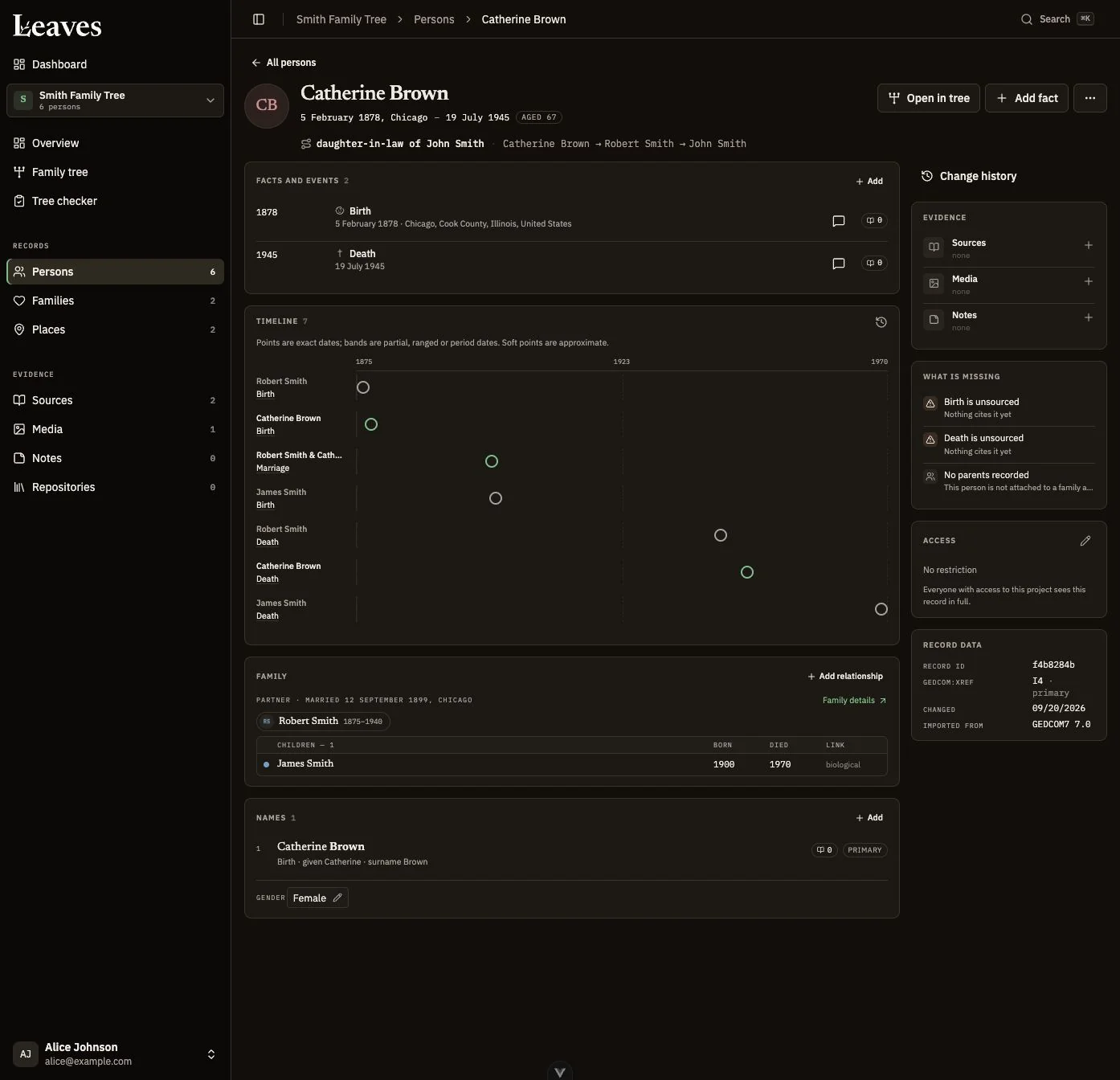
In Leaves, sources and citations keep the record, page reference and evidence together. The sources manual explains how to add them to your project.
4. Keep uncertain dates and conflicting evidence
If you know only a year, enter a year. If evidence suggests “about 1850”, keep the qualifier. If two records disagree, preserve both accounts and write a note explaining which conclusion you currently prefer and why. Replacing a disagreement with a precise-looking guess makes it harder for the next researcher to understand your decision.
Leaves supports partial dates, approximate dates and ranges. Confidence belongs with the claim and its supporting evidence; one uncertain identification does not make every fact about a family equally uncertain.
5. Turn the missing detail into a research task
Write a specific next action: “Find the marriage entry naming Maria’s parents” is easier to act on than “Research Maria.” Note which collection, place and year range you plan to search. After searching, record what you checked even if you found nothing. That helps you avoid repeating the same search and shows what remains untested.
Research tasks in Leaves can stay linked to the person or family you are investigating. Keep photographs and transcriptions connected to those records so the next session starts with the evidence in reach.
6. Build privately and keep a copy of your work
You can begin with paper or use an online workspace. Leaves is family tree software for recording your own research; it is not an archive search engine that supplies ancestors. Create a free account, add a project and enter your first known person. The getting started manual walks through the account setup.
The Free plan includes one project, up to 20,000 people, 250 MB of storage and two viewer collaborators. A project is private to its owner and invited collaborators; review sharing and living-person visibility before inviting relatives. Export your tree periodically and keep the original scans separately. If you already have a tree elsewhere, follow the GEDCOM import checklist instead of retyping it.