

1. Record who appears and in what role
People surrounding an ancestor can lead you to another record. Start by distinguishing witnesses, informants, neighbours, officials and explicitly named relatives. Copy each person's name, role, age, occupation and residence where the entry gives them. Keep a role supplied by the document separate from a relationship you suspect.
The Verschoor project's owner permitted these examples of long-deceased people. The screenshots show existing production records. Historical readings are attributed to the project; the originals have not been independently re-read for this guide. No production records were changed for the examples.
These examples use informants in death entries. The same method can be applied to witnesses in other records, but this guide does not recast the informants as marriage witnesses. Their recorded roles are the starting evidence.
2. Distinguish named relatives from officials
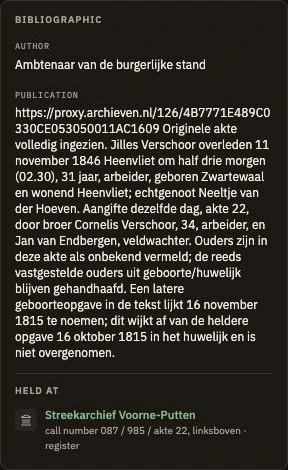
The reference is Heenvliet death register 1846, 087 / 985 / entry 22. According to the project, Cornelis reported Jilles's death with Jan van Endbergen. Cornelis's stated sibling relationship gives you a family question to check against other records. The constable's presence may reflect his official duties.
Do not infer a sibling relationship merely from the shared surname. Here, the project's reading explicitly says brother. To identify which Cornelis this was, compare the reported age, occupation, place and other records. A stated role connects the people in this entry before it identifies every other detail about them.
3. Avoid extending a relationship beyond its wording
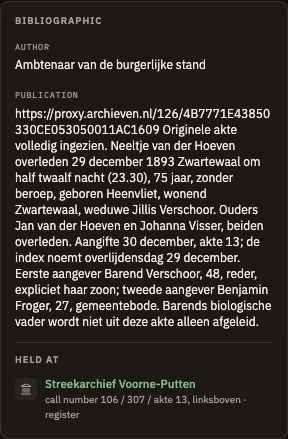
The reference is Zwartewaal death register 1893, 106 / 307 / entry 13. The project reports Barend as 48 and a shipowner, and Benjamin as 27 and a municipal messenger. Treat those ages and occupations as statements at that date, useful for distinguishing candidates.
Neeltje is also described as Jillis Verschoor's widow. Preserve both statements without combining them into an unsupported father-child conclusion. Use the parent-child evidence guide when researching Barend's parentage.
4. Look for repeated connections and alternative explanations
Search for the identified associate in other relevant entries. A recurring witness might be a sibling, friend, neighbour, colleague or local official. The pattern is a lead. Check whether the person appears widely in unrelated entries before interpreting repeated appearances as a special family connection.
Make a small list of actual appearances: date, entry, role and the people involved. Cite each occurrence. Do not write a pattern into your conclusion after finding only one appearance, and do not treat several websites copying one entry as several independent connections.
For the examples here, this guide establishes no repeated pattern beyond the cited project readings. Any further search for Cornelis, Jan, Barend or Benjamin remains a proposed investigation.
5. Record connections in the right place
When the evidence supports a family relationship, record it through the relevant family and explain its basis. For a connection outside parents, partners and children, Leaves offers associated people. Keep the dated appearance and its source in the research note even if you also record an association.
An association describes a connection you entered; it does not prove kinship. Avoid creating a person for every unexamined index name. Use the identity checks before attaching an existing person with the same name. The person controls and family controls provide the recording steps.
6. Choose a follow-up question the connection can answer
Turn the strongest lead into one task: identify the Cornelis described as brother in the 1846 entry, or find evidence that directly addresses Barend's parentage. Start with collection coverage and a justified date range. A reported age helps choose a range; it does not identify a unique candidate.
Record completed attempts and their limitations in your research log. Preserve the source's role wording even when your interpretation changes. The useful result may be a confirmed relative, an excluded namesake, or a clearer explanation of why an official appeared in the record.