

1. Ask what the place describes
A record can mention a birthplace, residence, place of death and place of registration. These may be different. Before entering a location, connect it to a particular statement: “Jilles lived in Heenvliet when his death was reported in 1846.” The archive holding the register is another location again.
The Verschoor project's owner permitted these examples of long-deceased people. The screenshots show existing production records. The historical readings come from the project; the originals have not been independently re-read for this guide. No production records were changed for the examples.
The project records Jilles, also called Jillis Verschoor, in Zwartewaal in 1837 and Heenvliet in 1846. This guide uses those dated facts to explain place handling. It does not establish the route he travelled or the date he moved between the two places.
2. Preserve the wording before standardizing it
Keep the source's place wording in a transcription, citation or note. Then identify the locality it refers to using the surrounding country, province, parish or municipality and the date of the record. An abbreviated or translated label may refer to the same place; a familiar spelling can also refer to a different locality.
The project's place catalogue contains several imported forms around Zwartewaal, including “of Zwartewaal” and abbreviated regional labels. Treat those as items to investigate. The word “of” may describe how a person was associated with a locality rather than being part of its name. Do not turn every imported phrase into a new mapped settlement without checking its context.
3. Review the place hierarchy and map suggestion
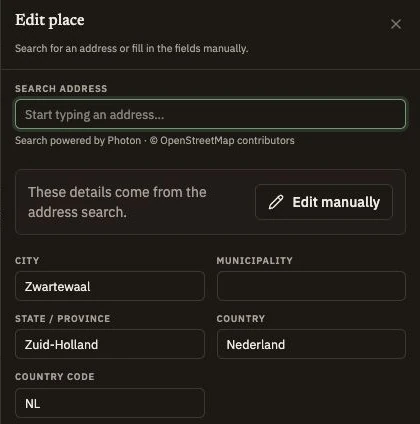
A modern address search can help locate a place. Check its result against historical evidence before using it to describe an earlier event. A modern municipality or national boundary may not match the one relevant to the document. Preserve the historical wording and explain any modern identification you add.
Coordinates can locate a town on a map without locating a particular house, church or burial. Use only the precision justified by your evidence. A text location remains useful when coordinates are unknown. See the place and map controls for manual entry, address suggestions and coordinate handling.
4. Date the location claim
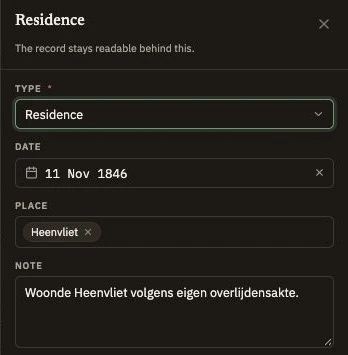
The relevant retained reference is Heenvliet death register 1846, 087 / 985 / entry 22. The project's reading also records the death in Heenvliet. Keep death place and residence as separately supported claims, even when their locations agree.
A marriage in one town does not by itself establish residence there. An entry may explicitly state a different residence for a spouse. Use the marriage extraction guide to keep each person's statements separate.
5. Check which events are linked to a place
In Leaves, a fact can retain a text place without being linked to a structured place record. Jilles's existing residence facts in this example use text locations. The separate Zwartewaal place record therefore should not be treated as a complete list of his connections to that town.
When a place page's event list looks unexpectedly short, inspect the relevant facts. Check whether they point to that place record, a different imported version, or text alone. Search existing places before creating another one. Review the affected event references before combining apparent duplicates, and preserve any meaningful historical distinction.
6. Use geography to plan the search
Once the locality is identified, determine which registers cover that place and period, which archive holds them, and whether a parish or civil jurisdiction matters to the question. Nearby places are research leads, not evidence that the person lived there. Verify collection coverage before interpreting an unsuccessful search.
Record the place, date range, collection and actual result in your research log. If a fact establishes only a dated presence, keep that limitation. Two locations at two dates can guide a search for migration evidence without proving when, how or why a move occurred.