

1. Keep precision separate from certainty
A date can be precisely stated and still be doubtful. A record might name a particular day while another gives a different month. Conversely, a year-only date can accurately reflect everything the source tells you. Record the known precision and explain how strongly the evidence supports it. Unknown day and month fields should stay empty.
These examples use historical research in the Verschoor project with the owner's permission. Cornelis Verschoor died in 1826; his father Jan was already deceased by that entry. The screenshots show their stored dates in production Leaves. The archive readings and our stated calculations are explained separately; the original documents have not been independently re-read for this guide.
2. Estimate a birth year without inventing a birthday
The project's reading of Cornelis's Zwartewaal death entry gives 15 November 1826 and an age of 72 (collection 106, volume 300, entry 24). Subtracting 72 from 1826 gives 1754. The project therefore records an estimated birth year of 1754, with year precision and a note that his own baptism record has not been inspected.
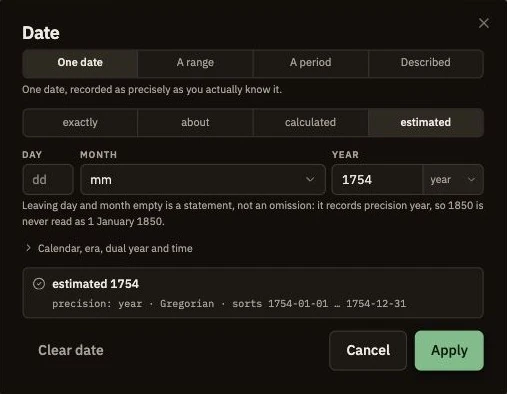
If the age means completed years and is accurate, the possible birthdays run from 16 November 1753 through 15 November 1754. That interval is conditional: an approximate or mistaken age could put the birth outside it. The project keeps the estimated year rather than turning this calculation into a proven birth range.
Do not enter 1 January 1754 as a placeholder, or infer 15 November 1754 by copying the death record's day and month. Neither birthday follows from the stated age. Preserve the age and the date of the record, label the estimate and search a sensible surrounding span rather than only one exact year.
3. Use before or after when you have a boundary
Cornelis's death entry also describes his father, Jan Verschoor, as already deceased. The project records this older Jan's death as before 15 November 1826. That is useful information even though his own death date is unknown. It does not mean that he died during 1826, or that every Jan Verschoor in Zwartewaal is the same person.
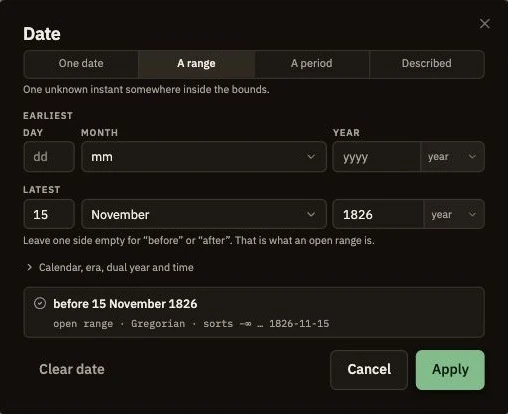
Apply the same care to “after”: a record showing someone alive on a certain date supplies a lower boundary for death, not a death date. Keep the citation on the bound so a later researcher can check exactly what the document establishes. Wording such as “by” can include the stated day; preserve it in a note when the distinction matters.
4. Choose a date shape that matches the evidence
- One date
- Use the known components: 1754, November 1826 or 15 November 1826. Add about, calculated or estimated when appropriate.
- A range
- Use when one event happened within bounds. One missing bound expresses before or after. Explain how the bounds were established.
- A period
- Use when a condition continued over an interval, such as a documented period of residence. It has a different meaning from uncertainty about one event.
- Described
- Keep wording you cannot confidently reduce to a date. A rough placement is optional; it should not replace the wording.
These are the four date shapes in Leaves. A known year does not need an approximation qualifier merely because its month is absent. “Estimated 1754” adds a different piece of information: the year itself comes from an assessment rather than a direct birth-date statement.
5. Enter the date and keep its explanation
- Open the fact's Date control and choose the appropriate shape.
- For Cornelis's birth estimate, choose One date, year 1754, and estimated; leave month and day empty.
- For his father's death boundary, choose A range and set only the upper bound to 15 November 1826. Check the displayed “before” interpretation.
- Choose Apply, then Save fact in the parent form.
- Cite entry 24 and explain the reported age or deceased-parent wording in a research note.
See the date editor manual for calendar and precision controls. Preserve the source's calendar and wording when historical dates require interpretation; avoid silently converting an ambiguous date. The uncertain dates feature page explains the supported representations.
6. Refine the date when better evidence arrives
An estimate is a research aid. When you find a baptism or birth entry, first check identity, place, relatives and the distinction between the ceremony, event and registration dates. A baptism date alone does not establish the birth day. Keep the earlier reasoning and explain why you refined or retained the estimate.
If two sources disagree, preserve both readings and use the conflicting evidence guide. Do not average two dates or remove the inconvenient citation. A short research task—find Cornelis's own baptism entry and check the parents—gives the uncertainty a useful next step.