

1. Give the log a question
A research log lets you resume work without repeating the same search. Begin with a question small enough to investigate: “Can a clearer copy of Jillis Verschoor's 1815 birth entry confirm the date reported in his 1837 marriage?” That is more useful than “Research the Verschoors”.
The Verschoor project's owner permitted these examples of long-deceased people. The screenshots come from production Leaves. Historical readings are attributed to the project; the originals have not been independently re-read for this guide.
The project already has a Dutch note comparing Jilles's records. It preserves a clear birth statement in the marriage, a faded birth entry, and a tentative different month in the later death entry. This is a saved research summary. It is not a dated log of every archive search, and the guide does not invent such a history.
2. Record each actual search as you do it
For each attempt, write the date you searched, the repository or website, the collection and coverage, the names or terms used, the entry or pages inspected, and the result. Include a reference another researcher can follow. Distinguish an index search from reading a register image, and say when access or legibility limited the attempt.
- Question: Which single point were you checking?
- Search and scope: Where did you look, under which spellings, over which years or pages?
- Result and reference: What did you find, fail to find, or remain unable to read?
- Interpretation: What does that result change, and what does it leave open?
- Next action: What specific check would now be useful?
These are prompts for a new log entry, not completed searches in this project. Leave an attempt unwritten until you have actually made it. A planned archive visit belongs in a task; a completed visit belongs in the log with its real outcome.
3. Keep results and conclusions distinguishable

In a new entry, separate what a document says from your interpretation. “The image is too faint for me to read the month” records a limitation. “The month must therefore be October” goes beyond it. If you later obtain a better image, add a dated follow-up explaining the changed reading and update the current conclusion.
Keep the source itself and its locator with the evidence. The starting references here are Zwartewaal birth register 1815, 106 / 282 / entry 37 and the 1837 marriage register, 106 / 292 / entry 12. A log explains your work on those items; a citation tells someone where to find them.
4. Give unsuccessful searches a boundary
“No birth found” is difficult to evaluate. State whether you searched an index or inspected images, which years and locality were covered, which name variants you tried, and whether pages were missing or unreadable. A result applies to that scope. It does not establish that the person was never born there.
Record different outcomes accurately: no matching entry found, collection unavailable, image unreadable, or candidate excluded. The faded entry in this case is already identified; the problem is its readability. Calling it a missing birth record would send the next researcher towards the wrong problem.
5. Turn the gap into one specific task
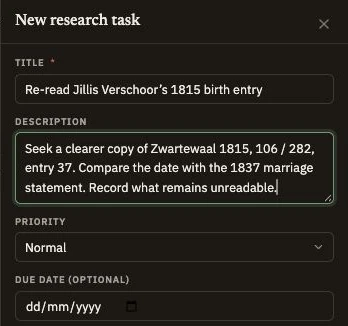
Choose an action with an observable outcome: request or locate a clearer permitted copy of entry 37, compare its wording, and record anything still unreadable. If available, the marriage supporting documents may offer a separate birth extract to examine. Do not mark the question resolved merely because the task is finished; an unsuccessful attempt can complete a task while leaving the historical question open.
Leaves research tasks keep the planned action and its outcome together. Use a task result to describe what happened, then update the linked research note if the evidence changes the conclusion. Keep “not yet attempted” distinct from “attempted without a usable result”.
6. Leave enough context to resume
Before stopping, check that a future reader can recover the question, search scope, result, evidence reference and next step. Use research notes for the longer comparison and attach them to the relevant historical records. A note shared by several records has one text, so edits should make sense wherever it is attached.
You do not need a long essay for every search. A few precise lines written at the time are often enough. Preserve earlier outcomes when you revise the current explanation, and link to the evidence comparison when an unresolved disagreement needs more space. The useful log is the one that tells you what has actually been tried.