

1. Preserve the handover before editing
An inherited family tree may contain years of careful work mixed with guesses, copied branches and missing references. Start by preserving what you received: the original genealogy file, photographs, scans, notes and any explanation of how the research was organized. Record who assembled it and when you received it. Work from a copy.
If the researcher can still explain their work, ask which branches they checked personally, which came from other trees, where originals are held and what remains uncertain. Keep their wording and attribution. A missing citation is a question to investigate, rather than proof that the conclusion is wrong.
The Verschoor project's owner permitted the historical examples and screenshots used here. Examples concern long-deceased people; account details and living-person records are excluded. Historical readings come from the project, and the originals have not been independently re-read for this guide. These are review examples, not a claim that the project itself was inherited.
2. Find out what you have
Make a short inventory of the genealogy file and its companions. Can you open the images? Are filenames referenced by the tree actually present? Are source titles accompanied by entry numbers, archive references or readable scans? Keep research logs and correspondence that explain a conclusion, subject to the permissions needed to retain and share them.
When bringing a GEDCOM file into Leaves, import your working copy into a separate project and inspect the import report. Follow the GEDCOM transfer checklist for names, dates, relationships and media. A successful import shows that the file was processed; it does not verify the historical research.
3. Review a small sample of claims
Choose a familiar person, a less familiar branch and one difficult conclusion. For each, ask whether you can recover the supporting entry, identify the right person and understand why a date or relationship was accepted. Sample exact dates, estimates, name variants and parent links so the review covers different kinds of claim.

The retained marriage reference is Zwartewaal 1837, 106 / 292 / entry 12. The project currently keeps 16 October 1815 as Jilles's birth date with qualified support. This is an example of a precise date whose evidential limitations need to survive a handover.
4. Review parent links before extending a branch
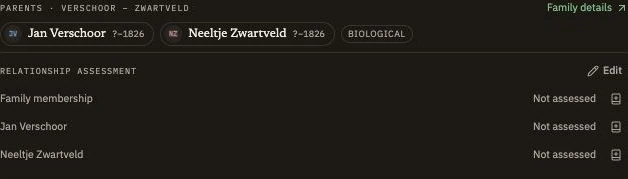
The project's reading of Cornelis's death entry, Zwartewaal 1826, 106 / 300 / entry 24 names those parents. A review should examine the connection and its identification before adding an earlier generation. Do not replace the older Jan with another Jan because a copied branch supplies more ancestors.
Use the parent-child evidence guide and identity checks for uncertain links. Keep unsupported material available for investigation without presenting it as established.
5. Make a review plan you can finish
Group your findings into supported claims, questions requiring a source check, and clear recording problems such as a missing image file. Start with a connection that affects several generations or a record you can realistically retrieve. A software warning can guide the review, but a clean checker result does not certify the tree.
Write specific research tasks: recover an entry reference, compare a particular parent pair, or locate a missing scan. Record what you actually checked in the research log. Preserve the previous conclusion and explain a change instead of silently rewriting the inherited account.
6. Keep the researcher's contribution visible
Retain authorship, source notes and unresolved questions when you update the tree. Explain which work you have independently checked and which remains inherited. A useful handover can preserve a valuable lead even when its original source is not yet recoverable.
Before major merges or restructuring, make a fresh backup. Review living-person information before sharing with relatives. You do not need to verify every branch before using the tree; make its current level of review understandable and continue one supported connection at a time.