

1. State exactly what disagrees
Two records may disagree about a birth month while agreeing about a spouse and birthplace. Write the narrow question first: “Which birth date is best supported for this person?” Keep the records and their readings separate while you investigate. A disagreement is something to explain; it does not automatically invalidate everything either document says.
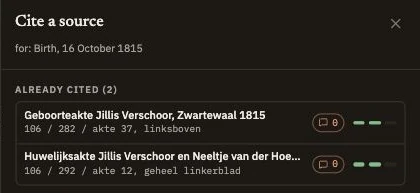
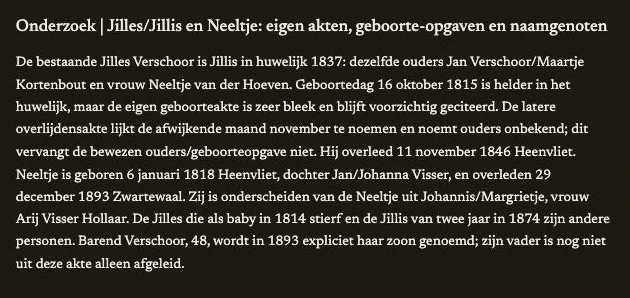
This case uses Jilles Verschoor, also recorded as Jillis, who died in Heenvliet on 11 November 1846. The Verschoor project's owner permitted these historical examples. The screenshots show the existing citations and research note in production Leaves. The archive readings come from the project; the originals have not been independently re-read for this guide. In particular, the possible November reading below remains tentative.
2. Check identity before comparing dates
A matching name is a starting point. Compare spouses, parents, places, occupations and the order of life events. Record name variants as written. Jillis in one entry and Jilles in another is worth investigating, but spelling alone cannot establish or rule out identity.
In this project, the marriage reading connects Jillis to parents Jan Verschoor and Maartje Kortenbout, and spouse Neeltje van der Hoeven. The death reading names the same spouse and birthplace, Zwartewaal. These connections explain the project's identification. The death entry reportedly leaves the parents unknown; that omission does not disprove the parents named in the marriage record. Do not merge a namesake merely to make a date problem disappear.
3. Compare each piece of information
Ask who supplied the information, how close the record was to the event, whether the reading is clear, and whether apparently separate accounts may copy the same earlier record. An index and its underlying scan are two representations of one item, not two independent witnesses. A later document can contain reliable information, but its birth statement needs its own assessment.
Here the marriage entry is useful because the project reports a clear date. It was nevertheless created more than twenty years after the birth. The birth entry is closer to the event, but its faded text limits what can currently be read. The death entry's possible November reading is later and uncertain. These are reasons to investigate, rather than a rule that the earliest record or the largest number of matching websites must win.
Consult the linked records: Zwartewaal birth register 1815, 106 / 282 / entry 37; Zwartewaal marriage register 1837, 106 / 292 / entry 12; and Heenvliet death register 1846, 087 / 985 / entry 22. These are the archive references retained in the project.
4. Check the arithmetic without rewriting the source
The marriage reading has an additional tension: it gives an age of 22 on 14 October 1837, while stating a birth date of 16 October 1815. On those dates, the 22nd birthday would be two days later. That calculation identifies a discrepancy. It does not tell us whether the age was approximate, a date was misreported or the handwriting needs another look.
5. Write a conclusion another researcher can revisit
A useful conclusion names the preferred claim, its supporting evidence, the alternative and what remains unresolved. The project currently retains 16 October 1815, with medium confidence on the birth citations. That is a precise date with qualified evidential support. It should not be described as a fully settled birth simply because all three date components are present.
Working conclusion based on the project notes: retain 16 October 1815 because the marriage reading states it clearly. Preserve the possible November reading from the death entry and the inconsistent marriage age. The faded birth entry still needs a fresh reading before the discrepancy can be considered resolved.
This is an editorial summary, not a quotation from an archive document. In your own research, cite each claim using the source citation guide. Leave the conclusion open if the evidence cannot support a preference. Two conflicting exact dates do not by themselves establish that the event occurred somewhere between them.
6. Preserve the evidence and choose the next check
In Leaves, keep citations on the relevant facts and attach a research note for the comparison. If you retain separate conflicting facts, identify which reading supports each one. Citation confidence describes an assessment of evidence for a claim; relationship assessment concerns a parent connection. Neither should be changed merely because another part of the person's record is uncertain.
Create a specific research task: obtain a clearer image or permitted alternative copy of Zwartewaal birth entry 37, compare the date wording and record unreadable passages. If available, check the marriage's supporting documents for an independently readable birth extract. Record what you actually found, including an unsuccessful attempt.
Before calling the conflict resolved, check that another researcher can follow the references, see both readings and understand why your conclusion changed. Until then, a documented provisional conclusion is a useful research result.